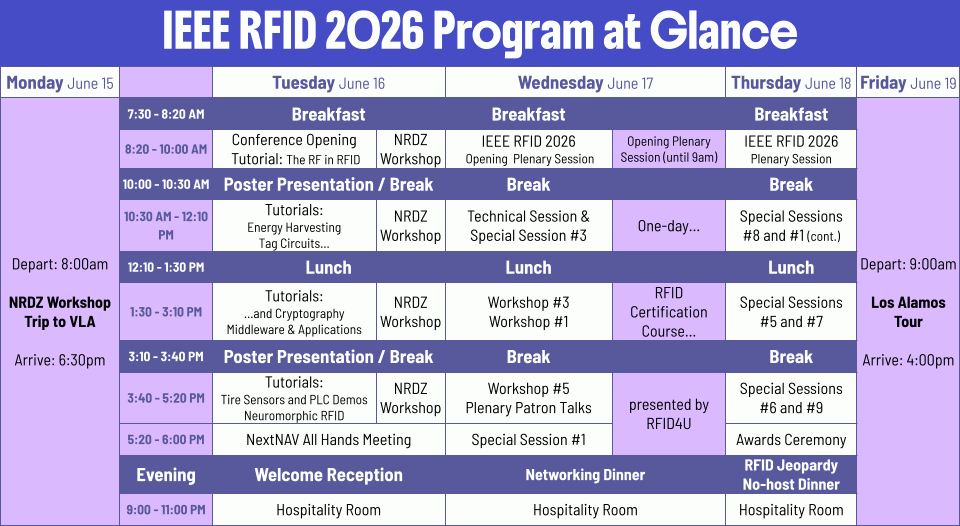
*** Celebrating the 20th Anniversary of the IEEE RFID Conference! ***


Exciting Days
Tuesday - Thursday, 16 - 18 June, 2026
Santa Fe, NM
IEEE | CRFID
Attendees will receive a complimentary Bluetooth Low Energy badge celebrating the 20th anniversary of the IEEE RFID conference (100 badges available).
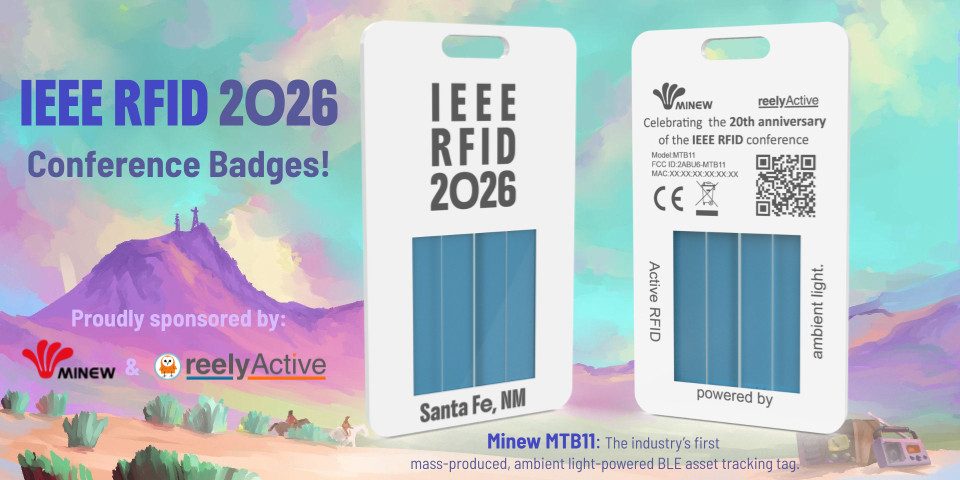

Founder, former editor RFID Journal
President RFID Professional Institute
Abstract
Each year for the past two decades, pundits have announced that this is the year radio frequency identification takes off, and each year, the pundits have been wrong. Mandates from Walmart didn’t spur mass adoption. Regulations requiring the tracking of unique doses of medicines didn’t get companies to deploy RFID. Massive improvements in the performance of passive UHF RFID systems and dramatically lower prices for tags and readers hasn’t led to mass adoption—even in the apparel retail industry, which has led all sectors in deploying the technology.
So, what’s preventing RFID from becoming as ubiquitous as the bar code?
Mark Roberti covered RFID technology for 25 years, first as the founder and editor of RFID Journal, and more recently as president of the RFID Professional Institute. He has spoken with hundreds of companies interested in deploying RFID, with solution providers creating products for the market and researchers in the labs. In this presentation, he will share his thoughts on why RFID hasn’t reached mass adoption, what needs to be done to accelerate the current growth of RFID and insights into the market opportunities currently being overlooked.
Abstract
[…] Even though the “golden age” of chipless RFID may be in the past, many opportunities still remain for new types of chipless RFID to meet demanding application requirements. New types of low-cost RFID reader designs, signal processing, and artificial intelligence now enables access to new materials signatures; and new types of electro-optical and smart materials now provide new mechanisms for encoding information. While the commercial and academic RFID field seems mired in UHF back-scatter technologies, it is imperative to break out of this thought bubble and continue to explore other frequencies of operation, other types of electromagnetic coupling, other types of representation besides frequency, and other types of materials. Several research groups, including the MIT Auto-ID Lab, have also begun to explore “Hybrid” RFID tags, which combine both chip and chipless components to create new families of RFID labels. The field of chipless RFID has also taught us that chipless signatures exist naturally in many materials and devices in our environment. By designing a “Smart Reader” that can operate at all RF frequencies, as well as optical frequencies, ultrasound, and molecular sensing in the form of olfaction, it is now possible to consider “Smart Reader” appliances that employ detection methods that are not only chipless, but also “tagless,” in order to automatically identify and sense the objects, materials, food, and living things in our environment. The future is only limited by our imagination.
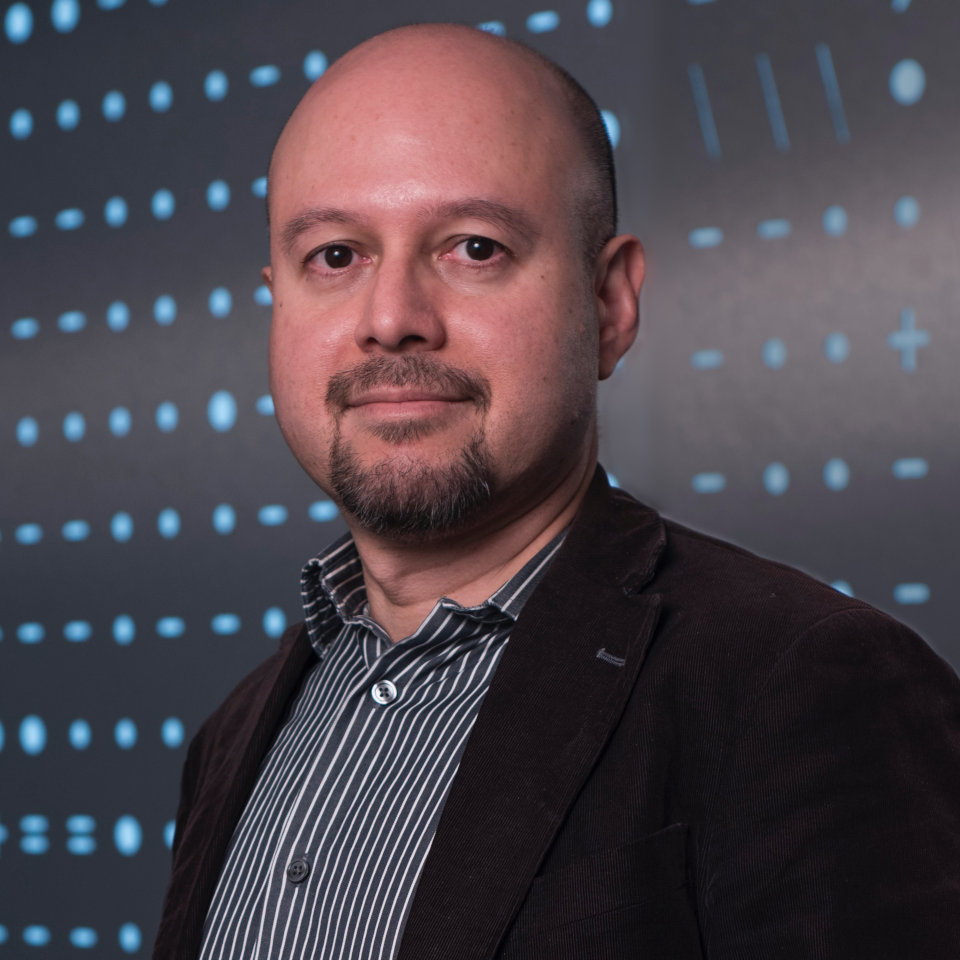
Research Scientist, MIT
Visiting Scientist, MIT Lincoln Laboratory
Research Faculty, Massachusetts General Hospital

Full professor, Universitat Pompeu Fabra
Director of Innovation, Keonn Technologies
Abstract
[…] In this presentation, I will argue that RFID, as originally defined by the Auto-ID Labs, has far exceeded initial expectations. I will show how, in the most advanced current deployments, objects are no longer detected only occasionally and at discrete locations, but can be detected pervasively and continuously: everywhere, all the time. As a result, RFID-tagged objects can in these cases be considered permanent nodes in a physical network.
I will also present examples of how this physical network can be combined with other sensors, such as cameras and ultra-wideband (UWB), using AI-enabled sensor fusion to generate a digital twin of physical reality, a rich, dynamic dataset representing the state and evolution of objects, people, and their interactions.
In the digital world, interactions of people with digital objects, “clicks”, and their AI-driven analysis (“clickstream analysis”) have been a key driver of the success of most online businesses, particularly in the growth of e-commerce. In an analogous way, the use of RFID and sensor fusion to detect “cricks” (a term we coined as a portmanteau of “clicks” and “brick-and-mortar”) enables AI, physical AI, to analyze, optimize, and predict the evolution of the physical world in specific contexts, especially logistics and retail.
RFID everywhere, all the time, is no longer a vision. It is already being deployed and is becoming an essential element in a world where all objects, people, and information systems are permanently connected.
Abstract
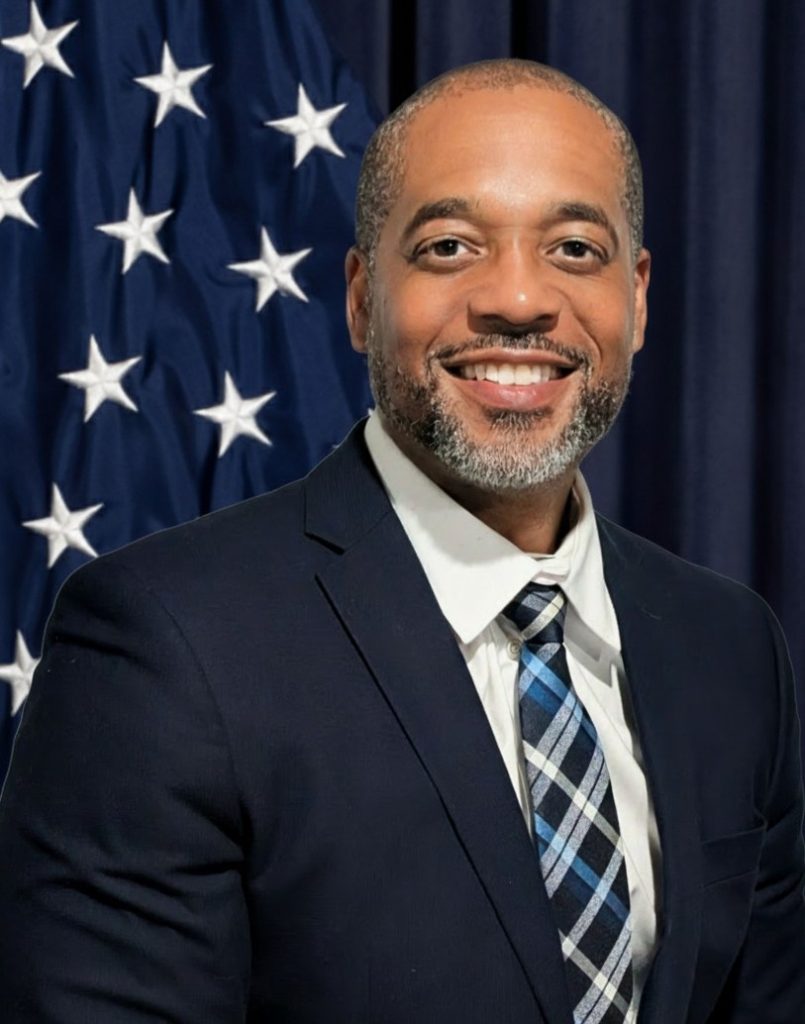
As global demand for wireless connectivity continues to surge, the way we manage and use the radio frequency spectrum is entering a period of rapid change. This keynote will explore the critical role of the National Telecommunications and Information Administration (NTIA) and its Office of Spectrum Management (OSM) in guiding this transformation.
We’ll provide an update on the status of the band studies required under the Working Families Tax Cut Act. These studies are set to begin this summer and late fall, and they represent a pivotal opportunity to shape how spectrum is accessed and shared in the years to come.
A particularly exciting area of innovation is the rapid commercialization of space-based communications. With a renewed regulatory focus on space—streamlining satellite licensing, updating orbital debris rules, and opening up vast swaths of satellite spectrum—new services are emerging that promise to reshape global connectivity. Among the most promising is direct-to-device (D2D) satellite service, which is already enabling basic emergency communications and messaging directly to consumer smartphones. These early offerings, driven by partnerships between mobile and satellite operators, are expected to expand dramatically, bringing us closer to a future where seamless, global, device-level connectivity is a reality.

Partecipate in several workshop on different and engaging topics like motion capture, flexible and 3D-printed electronics and many others!
The most skilled researchers in the field of RFID will participate in the event! Lays the foundation for your future collaborations!
Listen to the exciting seminary lesson of prestigious Keynote Speakers and exploit them to intercept the future trends in research activity!
Enjoy the unrivaled natural beauty and world-class attractions of the location.