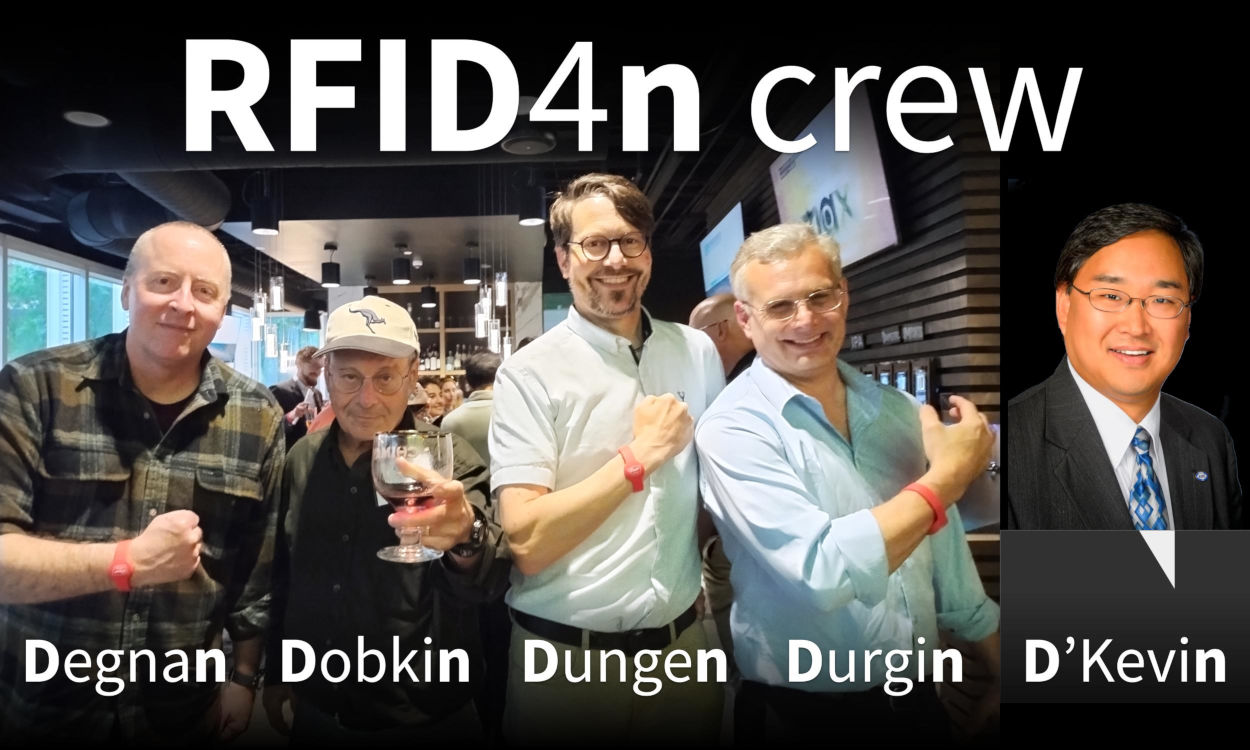
IEEE RFID 2026 Tutorial Session
The conference will begin with a full day of tutorials on Tuesday, June 16th, to introduce background helpful for the technical sessions. The tutorials will cover topics relevant to both passive and active radio frequency identification and sensing.
Daniel Dobkin is the author of The RF in RFID, and has been involved in semiconductor characterization and reliability since the days when a micron was small.
The RF in RFID
Presented by Daniel Dobkin
Radio Frequency Identification is, unsurprisingly, a radio technology. To understand it, you need to understand what radio waves are, and how they are generated, propagate and get detected. In this tutorial we review when radio can be more useful than light for identifying objects. We provide a simplified view of radio and antennas based on vector potentials and current sources to gain an intuitive understanding of what an antenna does and how it works, leading to the Friis equation for quantitation of transmitted and received signals. We examine why you need to modulate a signal, why specialized modulations are useful in passive RFID, and what you lose as a consequence. We introduce the structure of packets used in UHF RFID and Bluetooth Low Energy signaling, followed by a brief examination of how the radio medium is allocated for RFID tags and readers. We then examine the closely-related task of finding something after you’ve identified it, and how real environments complicate this problem with diffraction, reflection, absorption and consequent multipath propagation effects.

Greg Durgin is a professor at the Georgia Institute of Technology, with broad experience in radio-propagation, low-power circuitry, and the use of nonlinear devices in communications.
Energy Harvesting
Presented by Greg Durgin
Passive radio frequency identification depends on the ability to deliver power to the tag with radio waves instead of current on a wire. To accomplish this feat, the tag needs to have an antenna, and circuitry to match the antenna impedance to the circuitry that converts the radio wave to a DC signal. We examine the distinctions between near-field and far-field configurations for delivering power to the tag, and multiple-inductor approaches to stretch the near-field. We review various increasing-complexity schemes for rectifying the RF signal to get DC out, from a single diode to complex charge pumps and voltage boosters. We introduce power-optimized waveforms for improved rectifier performance, and examine how CMOS devices can be exploited to replace classic PN diodes. We end with a brief review of more exotic devices for conversion, and thermodynamic limits for any device.
Brian Degnan is a semiconductor design and process engineer with extensive experience in low power circuit design and cryptography for RFID, as well as characterizing advanced nodes at 3nm and beyond.
Circuits and Cryptography
Presented by Brian Degnan
Passive RFID is the ultimate constrained system due to area, time, cost and function. This tutorial gives an overview of what the RFID IC does after it receives power from the antenna. The transistor is mentioned, but the focus is on what the choice matrix is as a circuit designer and user of the ICs, which unwinds the paradox between laboratory behavior and the showroom floor. We will then explore the cost and benefits of cryptography on the RFID tags from both a technical and economic standpoint.

Jeffrey Dungen is the co-founder and CEO of reelyActive, where he develops and stewards open source middleware for IoT & RTLS. He has been a regular tutorial presenter at IEEE RFID since 2017.
Middleware / Applications
Presented by Jeffrey Dungen
RFID hardware generates data that can be used for plenty of applications, but the interfaces and the data itself may not lend themselves directly to application software. That’s where middleware comes in, bridging the gap between hardware and software, and fostering interoperability across vendors and technologies, so that real-time data about “things” in the physical world can be readily applied. This tutorial will present the motivations behind middleware, primarily in the context of RAIN RFID and Bluetooth Low Energy, including practical considerations and real-world examples. Discussion will extend to real-time location, wireless sensing and digital twins to enable digital representations of entire physical spaces. The tutorial will conclude with common applications using event-driven programming, databases, dashboards, AI and all-in-one platforms.
Kevin Berisso is the Director of the AutoID Lab at the University of Memphis, focused on the practical integration of RFID and visual code identification with automated materials handling and inventory management.
Applied RFID: Tires & PLCs
Presented by Kevin Berisso
Tires: The U.S. Federal Motor Carrier Safety Administration is trying to determine if passive RFID Tire Pressure Management Systems are a viable alternative to powered solutions. A brief discussion of the background, current options, and intended path for the testing of RAIN RFID based sensing will be presented, allowing opportunities for the audience to not only provide thoughts and suggestions, but to keep informed on the progress towards a working proof of concept.
PLCs: Every use case for RFID implicitly, if not explicitly, acknowledges the need to have RFID tagging occur as far up the supply chain as possible allowing for users to gain maximum benefit from its use. However, the stated intentions often fail to reflect reality, with company after company still incorporating a variant of “slap and ship.” Thanks to Zebra’s latest firmware, the barriers to incorporating RFID in the manufacturing environment have been significantly reduced, allowing for seamless integration of RFID into automation solutions. Join us as we explore the reality of integrating RFID into automation solutions and demonstrate some ways in which RFID is able to better interact with machine automation.
Neuromorphic RFID
Time permitting, a brief discussion of neuromorphic RFID will also be included in the tutorial session.
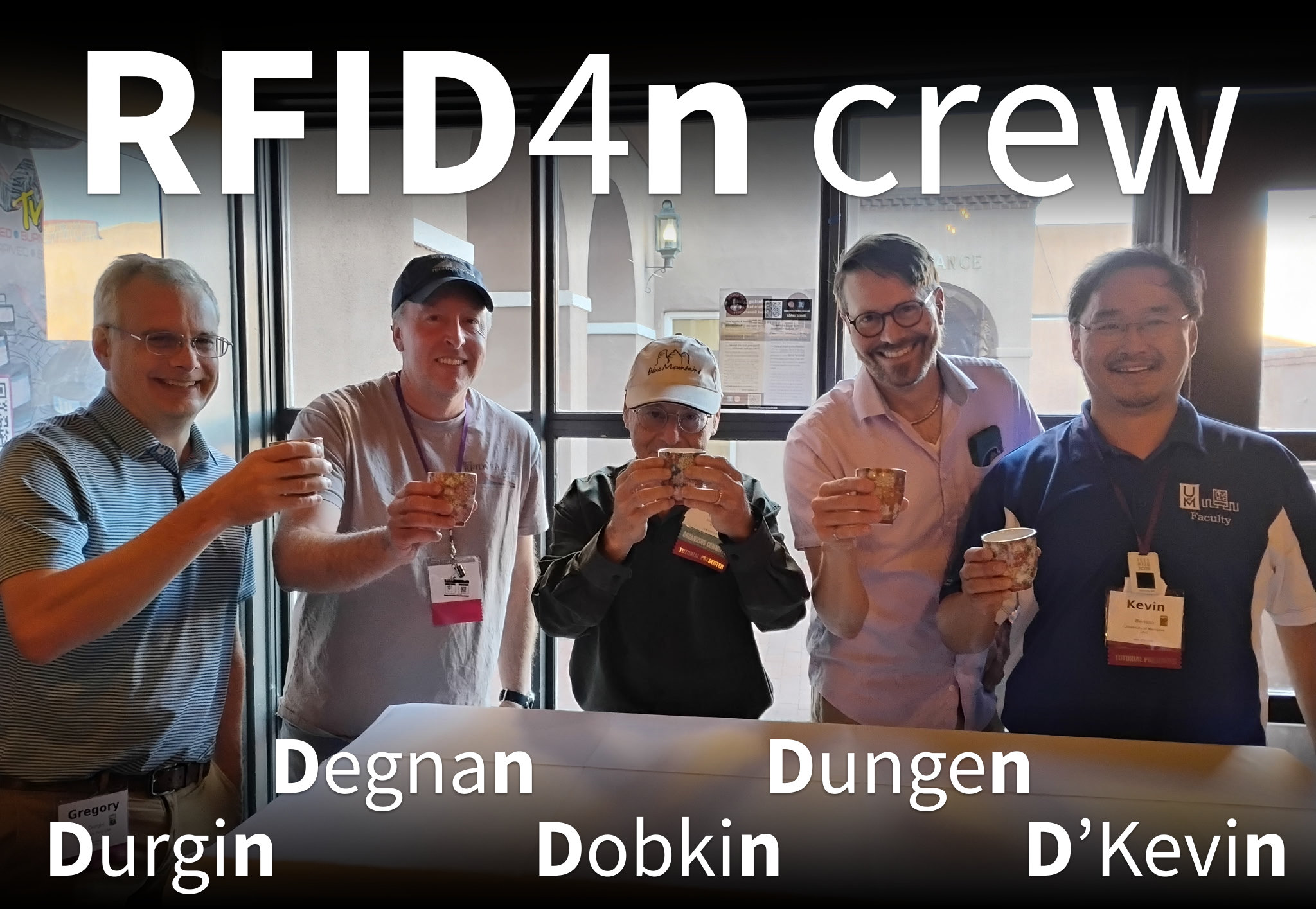
Above: The RFID4n Crew in Santa Fe, NM (2026)
Below: The RFID4n Crew in Atlanta, GA (2025)